Showing posts with label liberty. Show all posts

Friday, August 13, 2010

Immigration

This is a point where I am split. The immigration laws we have now, they suck. Period. But most of the laws we have now suck.

First of all; illegal immigration is so ubiquitous because employers can pay them less than "minimum wage", which in itself is a horrible idea. If a company raises the minimum wage they pay, then it follows suit they charge more for the product, making the product cost more and then the minimum wage worker can't afford the cheapest product. EXAMPLE: people who work at fast food restaurants; most likely the most food they can afford comes from fast food restaurants, but if the fast food restaurants raise the wage by x, then they raise the price by X/number of employees, so prices remain essentially static. But if the company can pay people "off the books" to work for less than "minimum wage"; the prices remain the same or get lower. So that gives companies an incentive to hire "illegals" who they pay less.

Second; Quotas; seriously, the federal government comes up with arbitrary numbers of how many people can come from each country.

Third; The welfare state: The more free shit wee give away the more people are going to want to get this free shit. Hell, people do all kinds of demeaning shit for free stuff, that's how "Girls Gone Wild" exists, not to mention people trying to force a 72 oz steak into stomach designed to hold like 2 pounds at max.

First off, we have to reform the country and get rid of the shit that is so attractive, and stealing money away from the people who have earned it. Second; until we clean up our system, get rid of quotas based on country of origin, just have a quota for immigration as a whole. Third: Those who ignore the laws now ARE CRIMINALS.

Just like most things, I don't think there should be many laws about immigration; but those who break the existing laws should still be punished. Case in point, drugs, I think all drugs should be legalized, period. Unless someone harms another person while under the influence of a drug they should be able to use or abuse it as they wish. But I still think those breaking withstanding laws should be punished. The "grandfather" clause only exists for people who broke a law before it was written, not those who broke it while it was in force.

We need to enforce the existing laws to show people how shitty our system is and to motivate the change of said laws.

So, in summation; Open boarders is the plan, fight the order, but obey the laws now on the books or get punished for no. The civil rights movement didn't ask for immunity, they took their ludicrous punishment and showed the world it was wrong!

Tuesday, May 11, 2010

The Boston Tea Party Was Over a Tax Cut?


You'll have to forgive me if I'm late to the party here; but I was educated in public school. I was always led to believe that The Boston Tea Party was done in outrage to high taxes. However, that was not the case; the Tea Act was actually a tax cut.

Yes, the act was designed to lower the cost of tea in the colonies and cut the taxes imposed on imported tea.

The point being argued wasn't really the the taxes, it was about cronyism. The East India Company complained to the King that Americans were not buying their tea because of the high taxes imposed on the goods. The company was paying a duty in England and the Colonies. To help out his friends at the East India Company the King eliminated the duty in England and lowered the tax in the colonies.

The outrage in the Colonies came from the fact that the act designated who could handle the product once it reached the states. The act set out a system that cut out American business an enriched the favored British merchants and bureaucrats.

From what I understand the President has been in the best schools in the country, so if he doesn't know this fact then it is a sad state of affairs. Worse yet, if he does know the truth, he ignores it for his own gain. Neither seems like a good proposition to me.

The Tea Act

British Parliment - 1773


An act to allow a drawback of the duties of customs on the exportation of tea to any of his Majesty's colonies or plantations in America; to increase the deposit on bohea tea to be sold at the India Company's sales; and to impower the commissioners of the treasury to grant licences to the East India Company to export tea duty-free.

WHEREAS by an act, made in the twelfth year of his present Majesty's reign, (intituled, An act for granting a drawback of part of the customs upon the exportation of tea to Ireland, and the British dominions in America; for altering the drawback upon foreign sugars exported from Great Britain to Ireland; for continuing the bounty on the exportation of British-made cordage; for allowing the importation of rice from the British plantations into the ports of Bristol, Liverpoole, Lancaster, and Whitehaven, for immediate exportation to foreign parts; and to impower the chief magistrate of any corporation to administer the oath, and grant the certificate required by law, upon the removal of certain goods to London, which have been sent into the country for sale;) it is amongst other things, enacted, That for and during the space of five years, to be computed from and after the fifth day of July, one thousand seven hundred and seventy-two, there shall be drawn back and allowed for all teas which shall be sold after the said fifth day of July, one thousand seven hundred and seventy-two, at the publick sale of the united company of merchants of England trading to the East Indies, or which after that time shall be imported, by licence, in pursuance of the said therein and hereinafter mentioned act, made in the eighteenth year of the reign of his late majesty King George the Second, and which shall be exported from this kingdom, as merchandise, to Ireland, or any of the British colonies or plantations in America, three-fifth parts of the several duties of customs which were paid upon the importation of such teas; which drawback or allowance, with respect to such teas as shall be exported to Ireland, shall be made to the exporter, in such manner, and under such rules, regulations, securities, penalties, and forfeitures, as any drawback or allowance was then payable, out of the duty of customs upon the exportation of foreign goods to Ireland; and with respect to such teas as shall be exported to the British colonies and plantations in America, the said dreawback or allowance shall be made in such manner, and under such rules, regulations, penalties, and forfeitures, as any drawback or allowance payable out of the duty of customs upon foreign goods exported to foreign parts, was could, or might be made, before the passing of the said act of the twelfth year of his present Majesty's reign, (except in such cases as are otherwise therein provided for:) and whereas it may tend to the benefit and advantage of the trade of the said united company of merchants of England trading to the East Indies, if the allowance of the drawback of the duties of customs upon all teas sold at the publick sales of the said united company, after the tenth day of May, one thousand seven hundred and seventy-three, and which shall be exported from this kingdom, as merchandise, to any of the British colonies or plantations in America, were to extend to the whole of the said duties of customs payable upon the importation of such teas; may it therefore please your Majesty that it may be enacted; and be it enacted by the King's most excellent majesty, by and with the advice and consent of the lords spiritual and temporal, and commons, in this present parliament assembled, and by the authority of the same, That there shall be drawn back and allowed for all teas, which, from and after the tenth day of May, one thousand seven hundred and seventy-three, shall be sold at the publick sales of the said united company, or which shall be imported by licence, in pursuance of the said act made in the eighteenth year of the reign of his late majesty King George the Second, and which shall, at any time hereafter, be exported from this kingdom, as merchandise, to any of the British colonies or plantations in America, the whole of the duties of customs payable upon the importation of such teas; which drawback or allowance shall be made to the exporter in such manner, and under such rules, regulations, and securities, and subject to the like penalties and forfeitures, as the former drawback or allowance granted by the said recited act of the twelfth year of his present Majesty's reign, upon tea exported to the said British colonies and plantations in America was, might, or could be made, and was subject to by the said recited act, or any other act of parliament now in force, in as full and ample manner, to all intents and purposes, as if the several clauses relative thereto were again repeated and re-enacted in this present act.

II. And whereas by one other act made in the eighteenth year of the reign of his late majesty King George the Second, (intituled, An act for repealing the present inland duty of four shillings per pound weight upon all tea sold in Great Britain; and for granting to his Majesty certain other inland duties in lieu thereof; and for better securing the duty upon tea, and other duties of excise; and for pursuing offenders out of one county into another,) it is, amongst other things, enacted, That every person who shall, at any publick sale of tea made by the united company of merchants of England trading to the East Indies, be declared to be the best bidder for any lot or lots of tea, shall, within three days after being so declared the best bidder or bidders for the same, deposit with the said united company, or such clerk or officer as the said company shall appoint to receive the same, forty shillings for every tub and for every chest of tea; and in case any such person or persons shall refuse or neglect to make such deposit within the time before limited, he, she, or they, shall forfeit and lose six times the value of such deposit directed to be made as aforesaid, to be recovered by action of debt, bill, plaint, or information, in any of his Majesty's courts of record at Westminster, in which no essoin, protection, or wager of law, or more than one imparlance, shall be allowed; one moiety of which forfeiture shall go to his Majesty, his heirs and successors, and the other moiety to such person as shall sue or prosecute for the same; and the sale of all teas, for which such deposit shall be neglected to be made as aforesaid, is thereby declared to be null and void, and such teas shall be again put up by the said united company to publick sale, within fourteen days after the end of the sale of teas at which such teas were sold; and all and every buyer or buyers, who shall have neglected to make such deposit as aforesaid, shall be, and is and are thereby rendered incapable of bidding for or buying any teas at any future publick sale of the said united company: and whereas it is found to be expedient and necessary to increase the deposit to be made by any bidder or bidders for any lot or lots of bohea teas, at the publick sales of teas to be made by the said united company; be it enacted by the authority aforesaid, That every person who shall, after the tenth day of May, one thousand seven hundred and seventy-three, at any publick sale of tea to be made by the said united company of merchants of England trading to the East Indies, be declared to be the best bidder or bidders for any lot or lots of bohea tea, shall, within three days after being so declared the best bidder or bidders for the same, deposit with the said united company, or such clerk or officer as the said united company shall appoint to receive the same, four pounds of lawful money of Great Britain for every tub and for every chest of bohea tea, under the same terms and conditions, and subject to the same forfeitures, penalties, and regulations, as are mentioned and contained in the said recited act of the eighteenth year of the reign of his said late Majesty.

III. And be it further enacted by the authority aforesaid, That it shall and may be lawful for the commissioners of his Majesty's treasury, or any three or more of them, or for the high treasurer for the time being, upon application made to them by the said united company of merchants of England trading to the East Indies for that purpose, to grant a licence or licences to the said united company, to take out of their warehouses, without the same having been put up to sale, and to export to any of the British plantations in America, or to any parts beyond the seas, such quantity or quantities of tea as the said commissioners of his Majesty's treasury, or any three or more of them, or the high treasurer for the time being, shall think proper and expedient, without incurring any penalty or forfeiture for so doing; any thing in the said in part recited act, or any other law, to the contrary notwithstanding.

IV. And whereas by an act made in the ninth and tenth years of the reign of King William the Third, (intituled, An act for raising a sum not exceeding two millions, upon a fund, for payment of annuities, after the rate of eight pounds per centum per annum; and for settling the trade to the East Indies,) and by several other acts of parliament which are now in force, the said united company of merchants of England trading to the East Indies are obliged to give security, under their common seal, for payment of the duties of customs upon all unrated goods imported by them, so soon as the same shall be sold; and for exposing such goods to sale, openly and fairly, by way of auction, or by inch of candle, within the space of three years from the importation thereof: and whereas it is expedient that some provision should be made to permit the said company, in certain cases, to export tea, on their own account, to the British plantations in America, or to foreign parts, without exposing such tea, to sale here, or being charged with the payment of any duty for the same; be it therefore enacted by the authority aforesaid, That from and after the passing of this act, it shall and may be lawful for the commissioners of his Majesty's treasury, or any three or more of them, or the high treasurer for the time being, to grant a licence or quantity of licences to the said united company, to take out of their warehouses such quantity or quantities of tea as the said commissioners of the treasury, or any three or more of them, or the high treasurer for the time being, shall think proper, without the same having been exposed to sale in this kingdom; and to export such tea to any of the British colonies or plantations in America, or to foreign parts, discharged from the payment of any customs or duties whatsoever; any thing in the said recited act, or any other act to the contrary notwithstanding.

V. Provided always, and it is hereby further enacted by the authority aforesaid, That a due entry shall be made at the custom-house, of all such tea so exported by licence, as aforesaid, expressing the quantities thereof, at what time imported, and by what ship; and such tea shall be shipped for exportation by the proper officer for that purpose, and shall, in all other respects, not altered by this act, be liable to the same rules, regulations, restrictions, securities, penalties, and forfeitures, as tea penalties, &c. exported to the like places was liable to before the passing this act: and upon the proper officer's duty, certifying the shipping of such tea to the collector and comptroller of his Majesty's customs for the port of London, upon the back of the licence, and the exportation thereof, verified by the oath of the husband or agent for the said united company, to be wrote at the bottom of such certificate, and sworn before the said collector and comptroller of the customs, (which oath they are hereby impowered to administer,) it shall and may be lawful for such collector and comptroller to write off and discharge the quantity of tea so exported from the warrant of the respective ship in which such tea was imported.

VI. Provided nevertheless, That no such licence shall be granted, unless it shall first be made to appear to the satisfaction of the commissioners of his Majesty's treasury, or any three or more of them, or the high treasurer for the time being, that at the time of taking out such teas, for the exportation of which licence or licences shall be granted, there will be left remaining in the warehouses of the said united company, a quantity of tea not less than ten millions of pounds weight; any thing herein, or in any other act of parliament, contained to the contrary thereof notwithstanding.

.

Monday, August 24, 2009

Echoes of the Past

I was reading, and this passage; which is preceded by Jefferson presenting offences of British Parliment and Crown prior to King George III, seemed to have a familiarity with todays political climate.

"That thus have we hastened through the reigns which preceded his majesty's, during which the violations of our right were less alarming, because repeated at more distant intervals than that rapid and bold succession of injuries which is likely to distinguish the present from all other periods of American story. Scarcely have our minds been able to emerge from the astonishment into which one stroke of parliamentary thunder has involved us, before another more heavy, and more alarming, is fallen on us. Single acts of tyranny may be ascribed to the accidental opinion of a day; but a series of oppressions, begun at a distinguished period, and pursued unalterably through every change of ministers, too plainly prove a deliberate and systematical plan of reducing us to slavery."

-Thomas Jefferson "A SUMMARY VIEW OF THE RIGHTS OF BRITISH AMERICA"

Addendum

This passage as well seems relevent:

"When the representative body have lost the confidence of their constituents, when they have notoriously made sale of their most valuable rights, when they have assumed to themselves powers which the people never put into their hands, then indeed their continuing in office becomes dangerous to the state, and calls for an exercise of the power of dissolution. "

-Thomas Jefferson "A SUMMARY VIEW OF THE RIGHTS OF BRITISH AMERICA"

Saturday, July 4, 2009

In Congress, July 4, 1776

The unanimous Declaration of the thirteen united States of America

When in the Course of human events, it becomes necessary for one people to dissolve the political bands which have connected them with another, and to assume among the powers of the earth, the separate and equal station to which the Laws of Nature and of Nature's God entitle them, a decent respect to the opinions of mankind requires that they should declare the causes which impel them to the separation.

We hold these truths to be self-evident, that all men are created equal, that they are endowed by their Creator with certain unalienable Rights, that among these are Life, Liberty and the pursuit of Happiness. That to secure these rights, Governments are instituted among Men, deriving their just Powers from the consent of the governed, — That whenever any Form of Government becomes destructive of these ends, it is the Right of the People to alter or to abolish it, and to institute new Government, laying its foundation on such principles and organizing its powers in such form, as to them shall seem most likely to effect their Safety and Happiness. Prudence, indeed, will dictate that Governments long established should not be changed for light and transient causes; and accordingly all experience hath shewn, that mankind are more disposed to suffer, while evils are sufferable, than to right themselves by abolishing the forms to which they are accustomed. But when a long train of abuses and usurpations, pursuing invariably the same Object evinces a design to reduce them under absolute Despotism, it is their right, it is their duty, to throw off such Government, and to provide new guards for their future security — Such has been the patient sufferance of these Colonies; and such is now the necessity which constrains them to alter their former Systems of Government. — The history of the present King of Great Britain is a history of repeated injuries and usurpations, all having in direct object the establishment of an absolute Tyranny over these States. To prove this, let facts be submitted to a candid world.

He has refused his Assent to Laws, the most wholesome and necessary for the public good.

He has forbidden his Governors to pass Laws of immediate and pressing importance, unless suspended in their operation till his Assent should be obtained; and when so suspended, he has utterly neglected to attend to them.

He has refused to pass other Laws for the accommodation of large districts of people, unless those people would relinquish the right of Representation in the Legislature, a right inestimable to them and formidable to tyrants only.

He has called together legislative bodies at places unusual, uncomfortable, and distant from the depository of their Public Records, for the sole purpose of fatiguing them into compliance with his measures.

He has dissolved Representative Houses repeatedly, for opposing with manly firmness his invasions on the rights of the people.

He has refused for a long time, after such dissolutions, to cause others to be elected; whereby the Legislative Powers, incapable of Annihilation, have returned to the People at large for their exercise; the State remaining in the mean time exposed to all the dangers of invasion from without, and convulsions within.

He has endeavoured to prevent the population of these States; for that purpose obstructing the Laws for Naturalization of Foreigners; refusing to pass others to encourage their migrations hither, and raising the conditions of new Appropriations of Lands.

He has obstructed the Administration of Justice, by refusing his Assent to Laws for establishing Judiciary Powers.

He has made Judges dependent on his Will alone, for the tenure of their offices, and the amount and payment of their salaries.

He has erected a multitude of New Offices, and sent hither swarms of Officers to harrass our People, and eat out their substance.

He has kept among us, in times of peace, Standing Armies without the Consent of our legislatures.

He has affected to render the Military independent of and superior to the Civil Power.

He has combined with others to subject us to a jurisdiction foreign to our constitution, and unacknowledged by our laws; giving his Assent to their Acts of pretended Legislation:

For Quartering large bodies of armed troops among us:

For protecting them, by a mock Trial, from Punishment for any Murders which they should commit on the Inhabitants of these States:

For cutting off our Trade with all parts of the world:

For imposing Taxes on us without our Consent:

For depriving us in many cases, of the benefits of Trial by Jury:

For transporting us beyond seas to be tried for pretended offences:

For abolishing the free system of English Laws in a neighbouring Province, establishing therein an Arbitrary government, and enlarging its Boundaries so as to render it at once an example and fit instrument for introducing the same absolute rule into these Colonies:

For taking away our Charters, abolishing our most valuable Laws, and altering fundamentally the forms of our Governments:

For suspending our own Legislature, and declaring themselves invested with power to legislate for us in all cases whatsoever.

He has abdicated Government here, by declaring us out of his Protection and waging War against us.

He has plundered our seas, ravaged our Coasts, burnt our towns, and destroyed the lives of our people.

He is at this time transporting large Armies of foreign Mercenaries to compleat the works of death, desolation and tyranny, already begun with circumstances of Cruelty and perfidy scarcely paralleled in the most barbarous ages, and totally unworthy the Head of a civilized nation.

He has constrained our fellow Citizens taken Captive on the high Seas to bear Arms against their Country, to become the executioners of their friends and Brethren, or to fall themselves by their Hands.

He has excited domestic insurrections amongst us, and has endeavoured to bring on the inhabitants of our frontiers, the merciless Indian Savages, whose known rule of warfare, is an undistinguished destruction of all ages, sexes and conditions.

In every stage of these Oppressions we have Petitioned for Redress in the most humble terms: Our repeated Petitions have been answered only by repeated injury. A Prince, whose character is thus marked by every act which may define a Tyrant, is unfit to be the ruler of a free people.

Nor have we been wanting in attention to our Brittish brethren. We have warned them from time to time of attempts by their legislature to extend an unwarrantable jurisdiction over us. We have reminded them of the circumstances of our emigration and settlement here. We have appealed to their native justice and magnanimity, and we have conjured them by the ties of our common kindred to disavow these usurpations, which, would inevitably interrupt our connections and correspondence. They too have been deaf to the voice of justice and of consanguinity. We must, therefore, acquiesce in the necessity, which denounces our Separation, and hold them, as we hold the rest of mankind, Enemies in War, in Peace Friends.

We, therefore, the Representatives of the united States of America, in General Congress, Assembled, appealing to the Supreme Judge of the world for the rectitude of our intentions, do, in the Name, and by Authority of the good People of these Colonies, solemnly publish and declare, That these United Colonies are, and of Right ought to be Free and Independent States; that they are absolved from all Allegiance to the British Crown, and that all political connection between them and the State of Great Britain, is and ought to be totally dissolved; and that as Free and Independent States, they have full Power to levy War, conclude Peace, contract Alliances, establish Commerce, and to do all other Acts and Things which Independent States may of right do.

And for the support of this Declaration, with a firm reliance on the protection of Divine Providence, we mutually pledge to each other our Lives, our Fortunes and our sacred Honor.


John Hancock

Button Gwinnett
Lyman Hall
Geo. Walton

Wm. Hooper
Joseph Hewes
John Penn
Edward Rutledge
Thos. Heyward, Junr.
Thomas Lynch, Junr.
Arthur Middleton

Samuel Chase
Wm. Paca
Thos. Stone
Charles Carroll of Carrollton
George Wythe
Richard Henry Lee
Th. Jefferson
Benja. Harrison
Thos. Nelson, Jr.
Francis Lightfoot Lee
Carter Braxton

Robt. Morris
Benjamin Rush
Benja. Franklin
John Morton
Geo. Clymer
Jas. Smith
Geo. Taylor
James Wilson
Geo. Ross
Caesar Rodney
Geo. Read
Tho. Mckean

Wm. Floyd
Phil. Livingston
Frans. Lewis
Lewis Morris
Richd. Stockton
Jno. Witherspoon
Fras. Hopkinson
John Hart
Abra. Clark

Josiah Bartlett
Wm. Whipple
Saml. Adams
John Adams
Robt. Treat Paine
Elbridge Gerry
Step. Hopkins
William Ellery
Roger Sherman
Samuel Huntington
Wm. Williams
Oliver Wolcott
Matthew Thornton

Tuesday, March 31, 2009

The Un-Spoken Word

   When I hear people speaking of the politics of President Obama they never seem to use the correct words. Some call him a socialist; he might be, but few of his policies have shown that because with a few exceptions buisnessmen still own thier businesses. Some call him a liberal; but that is a really vague term, what does that entail? No, through his actions so far he has proven to be somthing which has yet to be named by the critics. A word so damning they dare not utter it. A word which has taken on a different connotative meaning than it's actual denotative meaning. A word that if one used it they would be called isane. But this word is the one which properly describes his actions. What is the word? Fascist.
   Through the years Fascism has become interchangable with Nazism; when in fact Nazism is only a type of fascism. Through this misconstrued meaning it has come to be believed that a Fascist must be a racist; but this is not the case. Fascism; put simply, is socialism light. Where in socialism the government actually owns all the businesses; in Fascism the businessmen own thier businesses, but the government tells them how to run it. This is exactly what President Obama; as well as the previous administration, has done. The government doesn't actually own General Moters, but yet President Obama is choosing who runs the company.
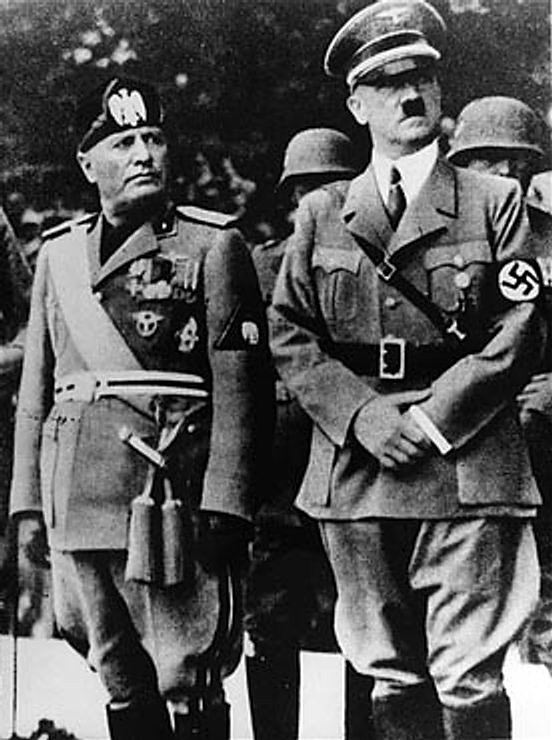
   Sadly, one fact of Nazism that is inherrent of Fascism is that with the extended power of the government in the business sector, they also take power in the civil sector. In 1932 Hitler's Fascist ally Benito Musselini put it like this, "...The Fascist State organizes the nation, but leaves a sufficient margin of liberty to the individual; the latter is deprived of all useless and possibly harmful freedom, but retains what is essential; the deciding power in this question cannot be the individual, but the State alone...." This sounds a lot like the attempts to limit smoking and consumption of fattening foods which have been happening these last few years.
Now the civil and economic factors are both there, so lets stop skirting around the issue.
    Let's not be afraid to use the correct terminology, because if what they are doing is so right, then why are they arfraid of naming it? If what you are doing is right, you have no such fears; only when you know what you are doing is wrong are you afraid to name it.

Tuesday, March 17, 2009

The Nature of Rights

So where do rights come from?  You may feel in your gut or have learned that each person has certain rights, but where do they come from?  Are they granted by Gods?  Are they granted by governments?  In my logical analysis; although God may have created nature, nature is the thing grants us rights; not God directly.  This is to say, the position of God on rights is vague, it all depends to whom you speak.  Where as nature has made it clear; in a state of nature each person has the right to their own body and the fruits of their labour.  In other words, property rights extending from the right of self ownership.
Then where does the right to free speech come from?  Well; your vocal chords are part of your body, therefore you can say what you want.
Then where does the right to free press come from?  Well; as long as you own the press or have permission to use it, that is an extension of your voice.
Then where does the right to religion come from? It is your mind and your body, do with it as you wish.
Then why is (stealing, murdering, beating...) wrong; because you have a right to your body, since it is property, and those whom harm your property are can be persecuted.
So why don't animals have this same right?  The key to human ability to have rights is based on the fact that humans as a species can understand rights.  If anyone can prove that another species understands t not only the benefit, but also the consequence of rights; then I will gladly grant that species rights.

Monday, March 2, 2009

Locke-Smiths

I have recently begun a group that I hope will be more than the average "we want this" political group; The Locke-Smiths, I hope, are more than a one issue band wagon.  There is one key issue, smaller government, but other than that it is up for debate on what exactly that small government should do as long as it does not infringe on life, liberty and property.  If you are into political philosophy and want to join a group that will actually attempt to make a change, I hope the Locke-Smiths can do it.

Saturday, February 21, 2009

Spectral Analysis


This is how I view the political spectrum, as a circle; starting and ending in anarchy. From anarchy you go counter-clockwise adding more governance. Notice; there are no distinct lines between categories; they simply blend together.

Anarchy: There is no state. There is no governance.

Anarchistic Capitalism: There is no state; all functions of government are performed willingly through capitalist transactions. There is slight governance.


Classical Liberalism: There is a very minimal state, performing only very simple duties; such as national defense and arbitration through courts; personal. liberty is of most importance. The state plays no role in the economy. Personal property is not infringed. There is slight governance.

Conservatism: The state has moderate power; providing defense, arbitration through courts, basic education and moderate taxation. Personal liberties are slightly infringed. The state plays a very small role in the economy. Personal property is slightly infringed. There is moderate governance.

Modern Liberalism: The state has extensive power; providing defense, arbitration through courts, extensive education, progressive taxation and social programs. Personal liberties are greatly infringed. The state plays a large role in the economy. Personal property is regulated by the state. There is extensive governance.

Fascism: The state has over-reaching power; providing defense, arbitration through courts, extensive education, progressive taxation and social programs. Personal liberties are greatly infringed. The state controls the economy through extensive regulation. Personal property is heavily regulated by the state. There is extensive governance.

Socialism: The state has almost complete control; providing defense, arbitration through courts, extensive education, progressive taxation and social programs. Personal liberties are severely infringed. The state controls the economy through ownership of all business. Personal property is completely regulated by the state. There is extensive governance.

Communism: The state has complete control; providing defense, arbitration through courts, extensive education, progressive taxation, social programs, clothing, food and housing. Personal liberties do not exist. The state controls the economy through ownership of all business. Personal property does not exist. There is complete governance.

Anarchistic Communism: There is no state. All functions of the state are performed by the majority in the community. Personal liberties are severely infringed. The economy is controlled by the majority in the community. Personal property does not exist. There is complete governance.

Anarchy: There is no state. There is no governance.


Governance:
  1. The act, process, or power of governing; government: "Regaining a sense of the state is thus an absolute priority, not only for an effective policy against . . . terrorism, but also for governance itself" (Moorhead Kennedy).
  2. The state of being governed.


Govern:

Gov"ern\, v. i. To exercise authority; to administer the laws; to have the control. --Dryden.


I would argue that the current Republican party is somewhere in the blending of conservatism and modern liberalism; the Democratic party is somewhere in the blending of modern liberalism and fascism; and ther Libertarian party is somewhere in the blending of classical liberalism and conservatism. I think true anarchy can not exist when there is more than one person; so it is very hard to come by in reality.

Friday, February 13, 2009

Marxy Marx

I thought this would be a good time to take another look at Karl Marx's ten steps to make a capitalist country into a socialist country, lets check off the ones already completed.

1. Abolition of property in land and application of all rents of land to public purposes.

Getting there; although we still may own our land, it isn't really ours, what with the abuse of emminant domain going on and all the regulations and zoning requirements put on the land.

2. A heavy progressive or graduated income tax.

Check

3. Abolition of all rights of inheritance.

Getting there; with the "Death Tax"

4. Confiscation of the property of all emigrants and rebels.

Well; we don't really have emmigrant issues or rebels, yet.

5. Centralization of credit in the banks of the state, by means of a national bank with state capital and an exclusive monopoly.

Check

6. Centralization of the means of communication and transport in the hands of the state.

Getting there; the government now contorls the big three automakers, Amtrak and is giving money away to telecommunications in the new recovery act.

7. Extension of factories and instruments of production owned by the state; the bringing into cultivation of waste lands, and the improvement of the soil generally in accordance with a common plan.

Well; with the state buying up everything, this could be happening, I'm not quite sure.

8. Equal obligation of all to work. Establishment of industrial armies, especially for agriculture.

It seems more like they don't want people to work at this stage, so as to get them on their side; this one probably isn't far off.

9. Combination of agriculture with manufacturing industries; gradual abolition of all the distinction between town and country by a more equable distribution of the populace over the country.

Check

10. Free education for all children in public schools. Abolition of children's factory labor in its present form. Combination of education with industrial production, etc.

Check

Thursday, January 15, 2009

These united states are not a Democracy!

You see it every where you look; from school books to TV even from our own federal government, that these united states are a Democracy.   But this is not, nor has it ever been the case.  From it's very inception this country has been a Constitutional Republic.  What's the difference? Well; in a Democracy it is rule of the majority directly or indirectly.  In a Direct Democracy every person votes on every issue and what ever the majority wants becomes law.  In an Indirect or Representative Democracy the people elect representatives who vote for them; but are still supposed to vote the way they think they people they are representing would vote, and what ever the majority wants becomes law.  On the other hand in a Constitutional Republic the people elect representatives who vote for them; but cannot make any law which abridges that of the contitution and do not need to vote how they think the people they are representing would vote.  The difference comes down to the power of the majority and collectivism.  If we define ourselves as a Democracy it is easy to do as we have been doing for past decades and assume what ever the majority wants is what should be law; say for instance in a Democracy if the majority want to own slaves, they're elected officials have no right to stop them.  However if this same place were a Constitutional Republic, even if the Constitution did not explicedly say slavery is wrong, the representatives have the right and the duty to tell the majority that slavery will be outlawed (unless of course the Constitution were to grant the right of slavery).  So, a Democracy can quickly lead to mob rule and harm the rights of others simply because the majority want to.  It may seem like a small difference, but come the time when you are in the minority, it can be a big difference.

*Republics are also explicitly categorized as not allowing monarchy, where as Democracies do not make that distinction.

Wednesday, January 7, 2009

Personal Vs Political

One thing I can't understand is why people can't seem to seperate their personal and political views.  To me it seems simple.  Political views have to be backed up by reason and logic; while personal views can be what ever crackpot idea you have.  I have a standard; the right to property, which all my political views have to live up to, so even if I personaly think something is right or wrong, if it does not uphold this standard then it does not become a political view.  There are many such instances, such as: Guns- politically I think they are a naccesity; but personaly I don't really like them (of course I like looking at them and learning about them and seeing them in movies, but I feel nervous around real guns) Religion- politically I think it has no place; personally I am very religious (although I don't believe in organized religion, I'm more of an independant study kind of guy) Sex- politically I could care less how someone enjoys their sexuality; personally I don't think sex belongs anywhere but a long term relationship. Money- politically I think it's a great thing, it makes the world go round, everyone should have as much as they can grab a hold of; personally I don't like big business and think people should only have what they need and share as much as they can.  Property- politically I don't care how much you have; personally I feel like too much property is a waste of space and would be fine in a one room shack (however I do like undeveloped land for recreation). Drugs- politically I think they should all be legalized and you only get into trouble if you harm someone (property of any kind) or come close to it; but personally I have not used an illegal substance for years and thier leagalization wouldn't affect me one or the other. Another thing is; politics is about people; personal views are about a person; singular.  In my personal and political views there is one thing in common, the golden rule "Treat others as you wish to be treated";  and to me that means leave me the fuck alone and let me live my life how I want to as long as I don't hurt you (or your property), and I'll do the same to you.

Friday, December 26, 2008

"I Kneel Before No Man"

That's a quote from "The Chronicles of Riddick"; a Vin Diesel vehicle which is a sequal to "Pitch Black".  The last few weeks I found myself saying that line to myself while watching movies about European Kings; as well as Christmas movies about Jesus;  as long as it is a person telling me what to do I will not, nor cannot, obey any rule which abridges the right of any other person to the basic rights of property.  As religious as I can be; if Jesus himself told me to take another persons property (including harming their body) I could not obey without a deep feeling of guilt.  "Kneel before no man;"  to me those are words to live by; no matter if he were elected by popular demand or annointed by God; "I kneel before no man."  


Addendum: I just recently watched the movie again and the quote is actually, "I bow to no man." But I think it makes the same point. 

Friday, December 12, 2008

Abortion

This seems to be a tough topic for people; as it is for me.  However, it is also very clear.  As soon as a child has a human body and mind, regardless of how well it works, that child has a right to it's body.   The mother also has a right to her body; therefore she has the right to remove the child.  But the current abortion procedure makes no attempt to remove the child without harming it's body; and therefore should not be legal.  A procedure where the child is romoved and affords it every chance to survive should be legal.  If every attempt is made to preserve the life of the child and it dies of natural causes outside the womb then it's rights have not been violated.  Whether the fetus is viable or even if no such surgery exists; non-lethal removal of the fetus, giving it at least a chance to live, is the only answer for a true libertarian.

Tuesday, December 2, 2008

The Government and Race

I am of the opinion that the government has no business knowing what race a person is.  It should not matter whether a person is white, black, asian, Native American or any other race, it is no business of the government.  Yes; 40 or more years ago the government needed to step in to to stop such inane laws as the Jim Crow laws in the south, but what business is it of theirs anymore?  In my experience; government preference of one race over another has only worked to strain the burgening relationships.  I grew up and still live in an area with with many Native Americans; many of whom were my best friends, but what made me feel any ill will towards them what so ever was the fact that they got special treatment fromt the government that I as a white child was not afforded.   The same goes for African Americans; I have many friends and even relatives whom are African American, and I feel no ill will towards them(in fact I have gone to fistacuffs over people using derogatory frasing towards them), but the government pushing obsurd tolerance laws and constantly telling me how racist I am by the fact that I am white is the only cause I have to feel ill will towards them.  I think if the government just kept thier noses out of our business there would be no problems.  Not to mention the government mishandles everything and then blames thier mishandling on racism.  See for instance the Beurou of Indain Affairs in this John Stossel clip:


Difference between Democrats, Republicans and libertarians

as of late i've been reading a book; ok, i'm listening to the audio version, but still; and it's very intriguing.  Of course I don't believe in everything aspoused in the book; as I would never presume to speak for another person and never presume to allow another person to speak for me, but I found one passage in particular which painted the difference between Democrats, Republicans and libertarians quite well:

Murray N. Rothbard

from;

For A New Liberty:

"Sometimes it seems that the beau ideal of many conservatives,
as well as of many liberals, is to put everyone into a cage
and coerce him into doing what the conservatives or liberals
believe to be the moral thing. They would of course be differently
styled cages, but they would be cages just the same. The
conservative would ban illicit sex, drugs, gambling, and impiety,
and coerce everyone to act according to his version of
moral and religious behavior. The liberal would ban films of
violence, unesthetic advertising, football, and racial discrimination,
and, at the extreme, place everyone in a “Skinner box”
to be run by a supposedly benevolent liberal dictator. But the
effect would be the same: to reduce everyone to a subhuman
level and to deprive everyone of the most precious part of his
or her humanity—the freedom to choose.
The irony, of course, is that by forcing men to be “moral”—
i.e., to act morally—the conservative or liberal jailkeepers
would in reality deprive men of the very possibility of being
moral. The concept of “morality” makes no sense unless the
moral act is freely chosen. Suppose, for example, that someone
is a devout Muslim who is anxious to have as many people as
possible bow to Mecca three times a day; to him let us suppose
this is the highest moral act. But if he wields coercion to force
everyone to bow to Mecca, he is thereby depriving everyone
of the opportunity to be moral—to choose freely to bow to
Mecca. Coercion deprives a man of the freedom to choose and,
therefore, of the possibility of choosing morally.
The libertarian, in contrast to so many conservatives and
liberals, does not want to place man in any cage. What he
wants for everyone is freedom, the freedom to act morally or
immorally, as each man shall decide."

Monday, November 3, 2008

The Moral of the Story

From Dictionary.com
mor·al (môr'əl,) Pronunciation Key
adj.
1. Of or concerned with the judgment of the goodness or badness of human action and character: moral scrutiny; a moral quandary.
2. Teaching or exhibiting goodness or correctness of character and behavior: a moral lesson.
3. Conforming to standards of what is right or just in behavior; virtuous: a moral life.
4. Arising from conscience or the sense of right and wrong: a moral obligation.
5. Having psychological rather than physical or tangible effects: a moral victory; moral support.
6. Based on strong likelihood or firm conviction, rather than on the actual evidence: a moral certainty.

Ok, so what many of the left say about Republicans is they want to legislate morality; this is how I used to describe it as well, until the other day when I was conversing a person of the left persuasion; then I realized that both Democrats and Republicans want to legislate morality. Because, as you can see above, there is no mention of the word religion in the definition of the word "moral". So, when you tell someone else how to live their life because you see it as wrong you are preaching morals, whether they come from the Bible or Al Gore; they are still morals. So Democrats get mad that the Republicans want to make laws using thier biblical morals, and the Republicans gets mad when Democrats try to make laws using thier environmental morals. So, when Democrats complain about Republicans legislating morals they are being hypocritical, they are mad they aren't legislating their morals.
As well as legislating environmental morals, making someone pay for a government program can also be enforcing morals. Let's take an example: welfare v American Family Housing. Welfare serves the same purpous as American Family Housing, they both take care of the poor. So, why should a person be mandated to pay for either? If you think wlfare works, then you should give your money to welfare, if you think American Family Housing works then you should give your money to them; you should not be forced to give your money to either. Just because you think welfare is better doesn't mean that I do. If someone wants to give to a program which they feel better fits their morals they should; but they shouldn't be forced to pay for one that doesn't.
So what laws should we make? Ones that protect property; your body is your property, so no one can harm you. Your land is your property, so someone else can't do something on their land that will harm your land, like dumping chemicals into the river; and so forth.

Saturday, November 1, 2008

From dictionary.com:

Marx·ism
[mahrk-siz-uhm] –noun the system of economic and political thought developed by Karl Marx, along with Friedrich Engels, esp. the doctrine that the state throughout history has been a device for the exploitation of the masses by a dominant class, that class struggle has been the main agency of historical change, and that the capitalist system, containing from the first the seeds of its own decay, will inevitably, after the period of the dictatorship of the proletariat, be superseded by a socialist order and a classless society.

com·mu·nism [kom-yuh-niz-uhm] –noun
1.a theory or system of social organization based on the holding of all property in common, actual ownership being ascribed to the community as a whole or to the state.
2.(often initial capital letter) a system of social organization in which all economic and social activity is controlled by a totalitarian state dominated by a single and self-perpetuating political party.
3.(initial capital letter) the principles and practices of the Communist party.
4.communalism.

so·cial·ism [soh-shuh-liz-uhm] –noun
1.a theory or system of social organization that advocates the vesting of the ownership and control of the means of production and distribution, of capital, land, etc., in the community as a whole.
2.procedure or practice in accordance with this theory.
3.(in Marxist theory) the stage following capitalism in the transition of a society to communism, characterized by the imperfect implementation of collectivist principles.


If the government owns a stake in our businesses what does that mean? That is socialism. Is socialism simply a regulation of our business', no, it is the government having stake in our business'. Deregulation is simply the government allowing business to do business, allowing milk producers to sell milk at the price they demand, allowing a company to offer health care at the price they demand, allowing companies to pay what they demand, but the government must demand that the company does not infringe upon your rights, mainly, once they own a stake in it, it is theirs. They can't enforce upon you anything you did not permit them to enforce. But didn't that cause our current economic problems? No, wrong, regulations did, regulations demanding that banks loan money to people whom the banks did not feel were suitable. Both parties were responsible for this. I said this four years ago when the presidential candidates were saying that everyone should own a home, no, everyone who can afford it should own a home, if they want. Deregulation does not mean that there should not be limits placed on companies, when they violate a persons rights they should be held responsible, But deregulation holds the key of competition, competition is responsible for every advance in human evolution.

Deregulation, does that mean no regulation? No, if someone has impeded one of your rights, of course you have a right to recourse, but does regulation hold the key? Regulation is the government telling the market what it should do, when in fact it should be the other way around, the market should tell the government what to do. Is it any coincidence that we passed the 16th amendment, allowing for the government to take income tax, then 13 years later we had the great depression? I'm not a conspiracy monger mind you, but I do not think those who run for office are usually qualified to run a company, so why should we let them run our companies?

But why is deregulation bad? It's not. The government should be there to protect us for our defense and stopping people from stealing our property. But bad regulations are bad. If they are there to stop them from stealing your property, then they are there to enforce the law. What more does one need? To keep themselves from being stupid? Well, that will never work, because no matter how hard one tries, there will always be stupid people.

Think the Right are the ones who abuse people, look at the left, they abuse eminent domain to increase the revenue base; the government takes (they pay them, but it is not a choice to not accept their offer) the land of a property owner to sell or give it to a business which will pay more in taxes. These laws are there for building roads and other necessities, but as of late they have been used to increase revenue bases for the government and for environmental protection.


Thursday, October 30, 2008

Constitutional Rights?

I'm getting fed up with the term "Constitutional Rights". Why? Because the term implies the Constitution gives you these rights, it doesn't. You have these rights by nature, the constitution simply says the government can't take them away. If they were granted by the constitution then by extension they are granted by the government. If they are granted by the government, then the government can take them away. They are not granted by anyone or anything, they implicit in human life; by right of being alive you have these rights. So please, don't say "It's my Constitutional Right", say, "It's My Right." No one can take your rights away unless you let them; so don't even let them think they can.

Addendum: The only entity granted anything by the constitution is the government, it is granted the power to mediate between us, not to rule over us.

Keep Your Liberty

Lately several people have posed the question to me, "why is socialsim so bad?" The short of it is because it take away individuality and free choice, it becomes about the collective. It gives government control over your entire being, the government will decide what's best for you, your health, your financial security, your thoughts; you become property of the government through proxy. So? It means I get free health care, home, etc. Well, free in the sense you may not pay directly for it; but you pay by proxy, someone else is paying for you; some one who is making more money than you. These people who pay, they are the ones who create jobs; the greedy rich. So let's play a little thought game; let's say I'm the greedy rich guy and you're the guy getting the government money; let's say I start off with $100 and you start off with $1. With my $100 I pay 10 other people $2, that means I have $80 left; of which the government takes $10, leaving me with $70. The government then gives you $2. So, I'm still way more rich than you, you have $3, I have $70. You spend $1 on my product and so do 3 of my workers, so now I have $74, you have $2. Again, I pay my 10 employees $2 each; now I have $54 dolars, of that the government takes $10; giving you your $2, you now have $4 I have $44. You spend $1 on my product, along with 5 of my employees. You now have $3, I have $50. Again, I pay each of my employees $2, leaving me with $30, the government takes $10, of which you get $2, I now I have $20, I'm still almost 3 times as rich you, but I cannot afford to pay all 10 empoyees or I would be broke, so I cut 5 jobs; and pay out $10 to my remaining 5 employees. See where this is going? It's deminishing returns. Of course this example is much simplier and quicker than reality, but this is how socialism works. Soon we are all equal, great right? Well, then who pays us? Well, the government of course, they bought my factory. Eventually once this happens to every business the government owns all the facotories; and we become communist.
"But what's so bad about communism?" We all get free healthcare and housing and a steady job. Well, now the government has too much invested in you, so to make sure we all stay healthy we need to all eat the same healthy food, wear the same cheap clothes, live in the same cheap building, work in an unsafe factory; to keep the cost down because there are no more rich people to tax to pay for the government. Now the government has to run like a business, but theres no competition, so it doesn't matter how they treat you. Sure, in a perfect world the government would treat us nice because it's the nice thing to do, but the world isn't perfect, so you won't get treated nice, you'll be a commodity.
But you say, "Well, the leader I elect to make us socialist won't be bad to us." Maybe, but you're giving them the power to do it, they may not use it, but that power is there now and you will have to fight like hell to wrest it away from the guy down the line who doesn't treat you right. The only way to avoid this is to keep that power out of anyone's hands, keep the power for yourself and your posterity like the people who founded these united states fought for and handed to us in the Constitution. Limit the size and power of government. Take respoonsability for yourself. Keep your liberty.

Subscribers